
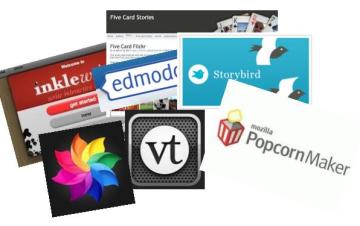
Last week, I spent the majority of my #etmooc time trying new digital storytelling tools (GIFs, Flip Books, Visual Poetry, 5 Card Flickr) and posting about my explorations and learnings. This week, I wanted to hold off testing more tools (PopcornMaker, Inklewriter & Stop Motion are high on my list!) so I could take time to reflect on the concept of digital storytelling and consider the value of it in the classroom.
Over the past few years, as I’ve learned of new tools and experimented with ways to engage children and adult learners in digital storytelling, I have been impressed with the depth of expression I have seen. Digital storytelling seems to break down barriers (e.g., fears, time concerns, language) that often prevent people from engaging in tech use. Once people see how easy a tool like Voicethread or Storybird can be to use, they are excited to tell their own stories and to collaborate with others in creating.
I think our motivation for connectedness and the inherently personal nature of stories is why I find digital storytelling so powerful. Everyone has a story to tell and I love providing my students and teachers with tools to bring those stories to life.
Last week, when I was experimenting with different tools, I was caught up in the excitement and natural engagement that comes from active learning and discovery and the knowledge that I had the power to create and share something with the world. It’s empowering to have that “I can do this” moment and to be able to add a new tool to your toolbox, one that is fun to use and allows you to convey a story in just the right way (whether that’s through visuals, audio, text, or some combination). I want all of my students to have those moments and realize that there is a large array of tools they can use to share their stories and they don’t all have to choose the same one.
As I thought about my explorations last week, I realized that another important factor motivating me to create and share was the knowledge that I was part of a community that was listening. I had an authentic audience that was waiting for stories just like mine and I was able to visit that community at any point to ask questions, find support, and learn from the stories everyone else was telling. I want to reflect more on the how valuable it is for our students to know they have an online community who is listening to them and willing to read their work and hear their stories. How can we cultivate that community for and with them? Certainly sites like Edmodo and hashtags like #Comments4Kids help but how can we ensure that our students aren’t sending meaningful projects and stories out into a silent and empty online space?
The benefits of incorporating digital storytelling in the classroom seem clear to me:
- Learn how to communicate/tell stories through different media (e.g., video, dictation, writing, pictures)
- Examine the value of different types of stories and storytelling methods (e.g., poetry, short stories, six word stories, picture stories)
- Build an understanding of technology as a tool to create and tell stories
- Provide opportunities for students to collaborate on stories
- Explore the ability to tell the same story in a variety of ways
- Identify ways that culture and context can affect a story and ways of telling a story
- Practice creating stories to teach an idea or new concept to others
- Gain comfort using, mixing, and re-mixing content and digital tools to create stories
I’m sure there are more but these seem like some of the core skills and understandings that can be acquired by incorporating digital storytelling in the classroom. They connect with the 21st Century Skills of communication and collaboration, creativity and innovation, and critical thinking. These are also skills that will be valuable as students grow older and need to tell stories on college applications or to their employers. When you pitch a new product or propose a new scientific investigation, aren’t you telling a story? The more I think about it, the more invaluable (digital) storytelling seems to become given how much of our lives we spend telling stories, in one form or another.
With that in mind, I want to re-examine my own curriculum and consider how digital stories are already being incorporated and if there are more/better ways to integrate them into our classrooms. We have already created a number of digital stories this year but I want to keep pushing myself and my students’ to continue discovering, experimenting with, creating, and sharing digital stories. How are you using digital storytelling in education?

A Digital Valentine Story
Image Credit: Sesame Street
Related articles
- Picture Poetry – More #ETMOOC Digital Storytelling (margaret-powers.com)
- Digital Storytelling as a Pedagogical Tool within a Didactic Sequence in Foreign Language Teaching (distance-educator.com)
- What is Storytelling? for #etmooc (cogdogblog.com)







 Margaret A. Powers
You must be logged in to post a comment.