Tag Archives: Early childhood education

Building an Infographic? Begin with a Blueprint.

infographic data

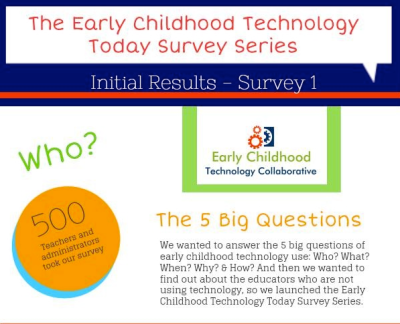
Recently, I had the chance to design and create my first infographic for some survey data collected on technology use in early childhood education. I was excited by the opportunity because it presented a new challenge and the chance to expand my tech skills in a new area.

I began, as I often do, with research. I reviewed some of my favorite infographics that I have saved on Pinterest to get a feel for what I was  looking for in my design. Then, I did a few Google searches to see what the top hits were for “creating infographics,” “designing your own infographic” and similar keywords. I was surprised at how old many of the top hits were, especially with sites like visua.ly recently launching their “create” function.

Still, after some digging I was able to find some good resources. There are a number of different sites that can help you create your own infographic. They vary in price and functionality and since I wasn’t interested in the $2,500 starting price for a custom infographic at visual.ly and needed to do more than pull data from Twitter or Facebook, I searched for other tools. I found infogr.am, which lets you choose from a few templates and then upload or add your data but there wasn’t an easy way to add my own icons, which was important for my design plan. Next, I discovered Piktochart and found that I could have a lot of flexibility with the colors, fonts, icons, and charts I used, even with their free service. Another platform, easl.ly, looks like it could also be promising but it’s still in beta and I found it after I had made my infographic and had some trouble with it freezing. Finally, this post on creating infographics just came out on 6/12 and has a number of additional resources.

Since I knew I wanted customized icons to clearly represent my data, I chose Picktochart as my platform and began to explore what was possible with the site and how to arrange my data. I quickly discovered that before I could make progress with my digital infographic, I needed to revert to old-fashioned pen and paper and sketch out a blueprint of my idea. In order for the content to be organized and flow methodically, I had to work out the connections between each piece of data and which ones were best displayed via a graph versus icons versus text. Ultimately, I used the key questions of: Who?, What?, When?, How?, and Why? (and why not?) to structure the flow of the data. Then after outlining everything on paper, I returned to Piktochart to put my blueprint into a digital format.

I adjusted the theme colors and fonts and then began searching Icon Archive for symbols that would represent my data (e.g., a smartphone). You can upload a maximum of 5 images under 1 MB using the free version of Piktochart and I have to say that when I ran into trouble deleting images (the trick is to delete them under Manage Uploads), their customer support was very responsive and helpful! After adding all of my icons and creating a systematic way of presenting each of my big questions, I reviewed my infographic in its entirety and asked a few colleagues to check it over. A second pair of eyes is always helpful to make sure the information will flow and make sense to another audience.

After that, I downloaded my infographic as an image (if you have the paid version you can also download the HTML) and now it’s ready for the world to see! You can find a small clip of it below and the full version is available on ecetech.net.
infographic

Looking to be a Change Agent? Find Your Community.

A "Collective Picture of Progress" created by people who drew a picture of themselves creating social change.

Creating change is hard.

Convincing people, especially those in power, that the change you are making is meaningful and beneficial, can be even harder.

On a daily basis, I work to bridge three different disciplines: early childhood education, global education, and educational technology. While I see clear intersections and connections between these three fields, I have come to understand that not everyone feels similarly. In fact, at points I have encountered strong opposition to merging any two of those fields together (e.g., early childhood and educational technology or global education and educational technology), let alone all three. I have heard comments that educational technologies, even when used in developmentally appropriate ways, do not belong in the classroom because young children cannot understand them and should be focused on basic skills instead. I have been told that digital formats are not as valid for presenting academic and professional resources and that young children do not need to be socializing or engaging with world citizens (through technology) because that can come later in life.

Given my Reggio-inspired, global lens to (early childhood) education, many of these comments concern me. I believe even very young children are capable of meaningful and deep reflection that can then be expressed in various mediums, including technology. I also feel that our world is becomingly increasingly connected across the globe and therefore it is advisable that as educators we expose young children to different cultures and ways of thinking about the world and provide opportunities for them to connect with other world citizens. And clearly, given the recent launch of my new website for early childhood educators, I believe that digital mediums can be a meaningful and practical way to present resources and ideas in an open and collaborative format.

These beliefs motivate me to continue to push the existing boundaries of the three fields I am passionate about and to work to join them together. Yet, in the face of opposition, I can at times become discouraged or overwhelmed. This is why I feel privileged to be part of such a supportive and amazing community, the education community. These people, whether we interact face-to-face or online, support my interests in #globalearlyedtech (and yes, I believe that’s the trifecta of hashtags!) and they provide encouragement when others discourage or question my work. They were the people who responded via LinkedIn, Twitter, email, and word-of-mouth when I reached out asking for people to take and share a survey for my master’s Capstone research. They were the people who reviewed my website, providing comments, suggestions, edits, and ideas. They are the people I know I can turn to when I want to brainstorm or make meaning of an educational concept and they push me to think more deeply, questioning existing practices so I can create innovative products.

This is a community that will provide encouragement and celebrate with me when I engage in educational projects:

@hechternacht tweeted: @donnaroman @SherriWyllie @iEARNUSA Definitely an incredible #ece resource!! Congratulations to @mpowers3 #kinderchat

It’s a community that will remind me to persevere when it seems impossible to create the change I’m hoping for by integrating #globalearlyedtech into the philosophies that educator’s and academic’s believe and teach:

@Matt_Gomez  tweeted: @mpowers3 reach others slowly, by never giving up and sharing the value. You never know what will be the tool/idea that works #ecetechchat

It’s a community that helps me to build new connections and reach out to new organizations so that I can share and learn with them:

@iEARNUSA tweeted: @ConnectStateGov #FF to @mpowers3 for new #ECE #GlobalEd resource site: bit.ly/H4I9xp #Exchange20

As @VickiEhlers tweeted “Share, share, share. And acknowledge the value of the what has been shared in a public way. Nurture relationships first! #ecetechchat

The relationships I have formed with the education community, a group I define as collaborative, inspiring, supportive, thought-provoking, and dedicated, provide the mental and emotional energy I need to create change. I have been inspired and honored by how many people have reached out to me through my new website and I cannot wait to collaborate and share with them, to learn from their ideas, and to build new meaningful relationships as I continue to expand my connections to the education community. I hope you’ll join me there!