
Wow, another year has gone by and we’re already three days into 2012! With the start of a new year, I wanted to take some time to reflect back on 2011 and things that I learned, accomplished, and hope to carry with me into the new year.
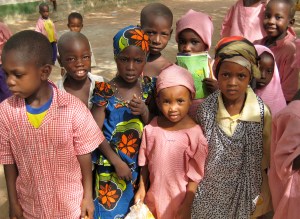 I think one of the most memorable things of 2011 will always be my first trip to Africa. As part of one of my master’s courses at American University, I traveled to Nigeria for two weeks in May to conduct research on the early childhood education available in the small town of Yola. I was amazed at the range of education practices and facilities I saw, ranging from mud buildings with a few tables and crayons to a fully-resourced, air-conditioned facility connected to the American University of Nigeria. The trip was a great reminder that no matter how many books you read or perspectives you hear on a country, there is nothing like walking into a new culture, hearing new languages and quickly trying to adapt to the local customs, food, weather, and everything else that goes with international travel! Some parts will always be easier than others, such as getting down on the dirt floors and playing with the children at the various schools I visited. Whereas trying to stay silent and honor the accepted cultural practice of corporal punishment (i.e., watching a four-year-old be repeatedly hit with a large, thick stick) is much, much harder. Overall, the trip was extremely educative. I learned a great deal about life in Nigeria, the education system there, and the importance of traveling with a flexible, supportive group (and protein bars … for when you can’t take one more day of rice and chicken!).
 Aside from my international travels, I had some great developments in my professional life in 2011. I had the opportunity to spend the summer working as a teacher at the Penn Children’s Center and loved getting to work closely with one preschool class. Our adventures included “traveling” from Japan to England, learning about the royal family, creating castles of all shapes and sizes, growing flowers and vegetables in our garden, and enjoying many days of water play!
Earlier this fall, I was able to start working as an Education and Technology Consultant, which has allowed me to learn a lot about webinar management, utilize more of my tech skills, and be more active in the field of early childhood. Consulting has allowed me to work with some great new colleagues, including @FSSimon and @KarenNemethEdM, which has been a real privilege. I’ve also really enjoyed helping to facilitate the Early Childhood Investigations webinars and if you haven’t checked them out, I’d highly recommend them, they’re free!
I also grew a lot as a learner and educator in 2011 through my master’s courses. I especially enjoyed Models/Methods in Early Childhood Curriculum; Global & Multicultural Education & Training; Training Design; and Critical Educational Psychology. These courses helped deepen my knowledge of approaches to literacy education in early childhood, critical theory and ways it applies to education and psychology, and how to design a meaningful training. I was able to take a fresh look at the works of Freiere, Vygotsky, Piaget as well as many new theorists and I had the chance to read a number of great texts. I would particularly recommend: Making Literacy Real, Critical Multiculturalism: Theory & Praxis, Learning to Listen, Learning to Teach.
 Of course a big part of my past year has involved a continued exploration of tech tools. As I wrote about in my first post, I discovered Storify not long ago and I have also been testing out Symbaloo, a great way to compile your favorite sites, as well as exploring new uses for the virtual cork board Lino. I also began using Picnik so I could add a watermark to the photos in my new Etsy shop. After following and reading many other papers, I finally decided to create my own #Tech, #GlobalEd & #EarlyEd paper.li and after being fairly inactive for a bit, I jumped back into LinkedIn in 2011, creating two new networking groups for my master’s program and finding other professional groups where I could join some great dialogues. Twitter was also a major part of 2011 for me, as I traveled to New Orleans to present on Twitter in liberal arts classrooms at the annual meeting of AERA, connected with more educators around the globe, began participating in more great chats like #kinderchat, and started tweeting for my program @ITEP_AU.
All in all, it was a pretty great year! I’ve loved the discoveries I’ve made, whether they’ve been in the field of international education, early childhood, or technology and the connections I have built will definitely be a big part of this new year. I’m excited to see what 2012 will bring and to start charting new waters, either here or abroad, so that I can continue to learn and grow and to connect educators around the globe.







 Margaret A. Powers
You must be logged in to post a comment.