
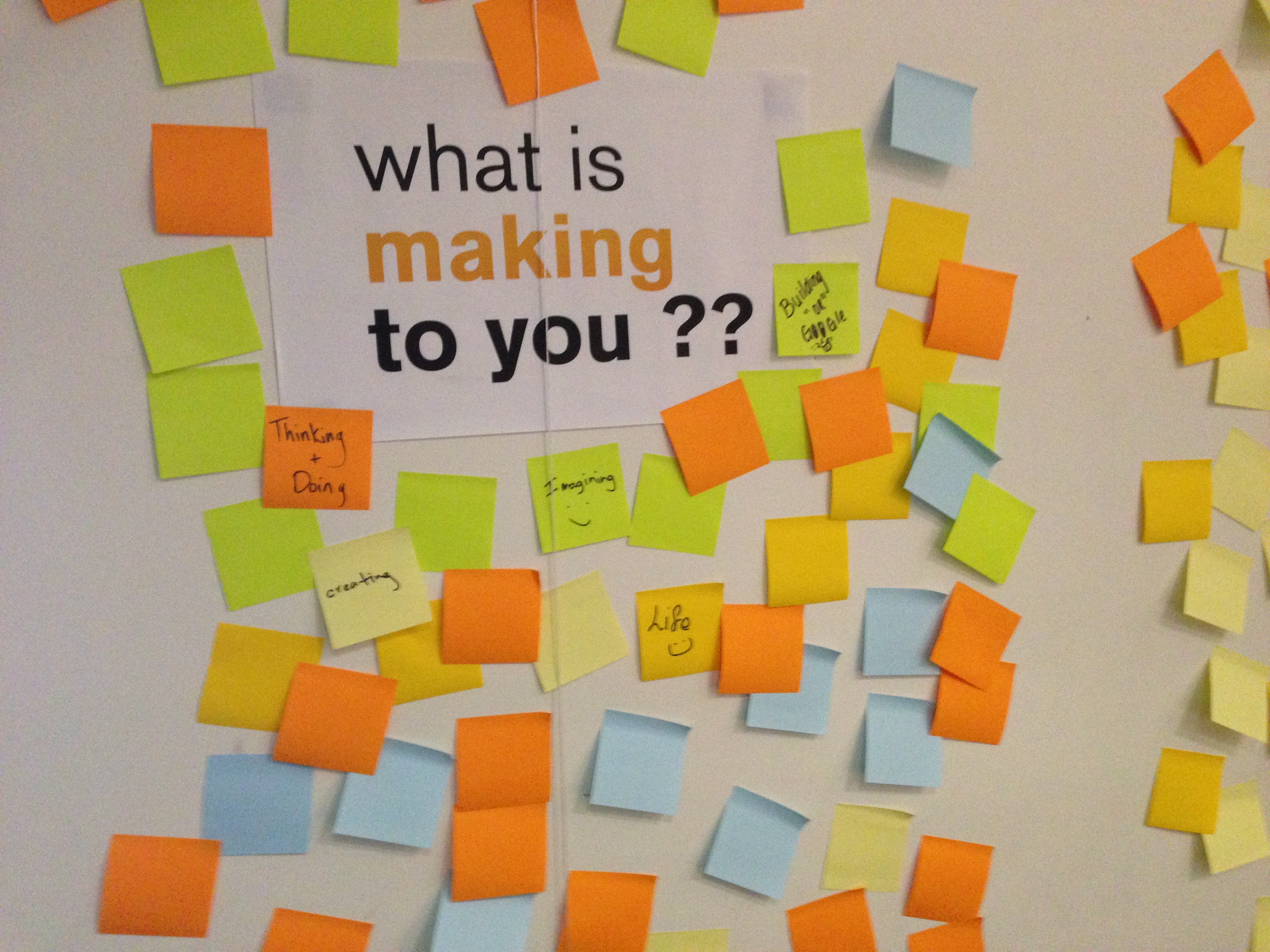
In the spirit of the Wonder by Design session I attended at Educon this past weekend, I thought I would summarize some of my ah-ha moments and key takeaways in an Educon Manifesto (in draft form, of course!). I see it as a manifesto for teaching and learning and maybe more importantly, something to post in my class for daily inspiration – a reminder of the work I want to do and why it’s essential.
Here’s the short version:

Here’s the long version:
Be a Wonderer
Because who wouldn’t want to be? Wondering leads to all sorts of inquiry and investigation and it’s often the impetus for meaningful dialogue and deep learning. We need it in all of our classrooms to drive exploration and sustain a sense of awe in our day-to-day work as educators.
Plus, as Loris Malaguzzi said,
“The art of research already exists in the hands of children acutely sensitive to the pleasure of surprise. The wonder of learning, of knowing, of understanding is one of the first, fundamental sensations each human being expects from experiences faced alone or with others.”
It seems vitally important that we don’t take that expectation away from our students or deny it from ourselves.
Prototype it!
If you’re interested in trying a new structure for your class or you’re considering building a new space in your school … prototype it! Design it and try it out before setting it in stone (which hopefully doesn’t happen to often in schools).
It seems simple enough but how often do we actually test out an idea and see how well it works and then get feedback from students and other audiences that will be affected by a change before we implement it?
Trying to imaging what school would look like if every classroom (& school) started as a prototype #educon #makered
— Margaret A Powers (@mpowers3) January 25, 2014
Make the Space You Need
After you’ve tested out a variety of prototypes and improved on the parts that have failed, get started making! Whether it’s a new school, a makerspace, a standing classroom, or a nook in the corner that just needed a redesign, take initiative to make your learning spaces into what you need them to be. It could be as simple as changing the lighting or it might be as complicated as working with architects and consultants to construct something completely new.
There’s plenty of inspiration out there and lots of resources to work with so let’s put on our Maker Hats and design the environments needed for a maker mentality and wonder to flourish.
Tinker with Technology, Don’t Just Use It

As Sylvia Martinez suggested in one of the #MakerEd sessions, computing is the game-changer in bricolage that allows us to dig into deeper learning and making. We need to tinker and experiment with technology and help our students learn how to create it for themselves so they can create new inventions for others.
Don’t consume tech –> Create it. Don’t take for granted how tech works –> Tinker with it until you find out!
Let “Real Life” into Your Classroom
Richard Culatta, Director of Ed Tech, encouraged educators to stop giving fictitious problem sets to students and instead to provide real life problems for them to solve.
There are so many real problems that we don’t have the luxury to make up problems for Ss to solve in class! via @rec54 #EduCon
— Margaret A Powers (@mpowers3) January 25, 2014
It’s time to start breaking down the artificial dichotomies between school and the “real world” so that students walk away with experience engaging in dialogue about current events and issues facing their communities. Let’s start asking students what problems they want to solve and making school a place to tackle them.
IT Starts With the Students & Always Will
A reminder about the importance and value of the learner and creating learner-driven classrooms. Our role as educators is to foster wonder and make spaces where students feel encouraged to learn. It’s easy to get caught up in the tasks, standards, and restrictions that seem to hold us back and turn our attention away from the students. Yet, our work has always been and will be, to honor their voices, respect their choices, and empower their actions as they make, tinker, problem-solve, and create anew each day.
Document, Document, Document … Reflect
 Although not a huge focus of #educon, documentation has been a highlight of my work this year as I explore ways to use Google Glass in the classroom. It seems that if we want to encourage wonder and focus on student interests, then we need to be constantly documenting the teaching and learning happening in our classrooms so we have material to review and reflect on. To be intentional in our teaching and help scaffold student inquiry, we need to act as researchers and reflective practitioners and to do that, we must start by documenting.
Definitions are Defined by Context
A big question in the Designing Learning Organizations session was “what is the new learning context?” Ultimately, we decided that the context is rooted in what we value and our values affect how we define learning and schooling. Therefore, if we want to create a new context for learning, we have to look at how we’re defining learning and make a space, as well as develop a mindset, that supports our desired definitions.
Basically, if we want to work and learn in organizations that are flexible, responsive, collaborative, and full of wonder, we have to take into consideration how we’re defining learning and how our space and context is shaping that definition, so we can understand what might need to change.
Decide to Always be Learning
Another topic under discussion at #educon was how to create change in traditional schools and envision a learning organization. A big part of the answer seems to be a mindset. Whether it’s a mindset for making, a mindset towards openness, or one of design thinking and PBL, you have to decide that you are going to engage in that work and commit to it.
I’m not sure that there’s any one mindset that’s best for all teachers and students aside from a mindset to always be learning. So decide that you want to keep growing and constantly continue to learn.
Learn to Keep Asking Questions
Questions were a hot topic at #educon. Some people talked about needing to ask the right questions, others encouraged making questions more inclusive “what if we …”, while another educator suggested that the goal is to “keep falling in love with the question” without finding The Answer.
Whether your questions are open-ended, categorized, or unanswerable, I think the most important piece is to keep asking them! Ask them over and over, in new ways and in old ones, just never stop asking questions.
http://instagram.com/p/ju2rNQOurm/
Stay Inspired & Keep Playing
In order to see wonder and come up with creative ideas for prototypes and spaces, we need a key ingredient: inspiration. It pushes us to tinker and guides us to question, it feeds our thirst for learning and helps us be open to new mindsets. Inspiration is the energy drink of educators and with it, we can take up @ChristianLong and @djakes charge to “assume epic success” and be “extraordinary!” My best advice is to stay inspired and keep playing – with ideas, with questions, with technology and most of all, with young children who can help us remember the “pleasure of surprise” and the “wonder of learning.”








 Margaret A. Powers
You must be logged in to post a comment.