

“[Making] is intrinsic, whereas a lot of traditional, formal school is motivated by extrinsic measures, such as grades. Shifting that control from the teacher or from an expert to the participant, to the non-expert, to the student, that’s the real big difference here.”
– Dale Dougherty (2013)
The creative work of making, often driven by imagination and problem-solving, can feel like a tricky thing to assess. Yet, if we look to the expertise of Grant Wiggins (2012), we are reminded that assessing creativity is not only a necessity but a helpful experience for students. It is through assessing creative thought and the impact it has on an audience or final project, that students develop the autonomy needed to self-assess and improve their own work.
Therefore, when thinking about the creative work of my young (Pre-K to 2nd grade) students, I spent some time reflecting on the best ways to assess them. I reviewed the creative rubric (Wiggins, 2012) and a maker rubric (Yokana, 2015) and many of the ideas shared in Meaningful Making: Projects and Inspirations for FabLabs and Makerspaces (Blikstein, et al., 2015).
I firmly agree that the right assessment for my students’ work was not a test (Flores, 2015a, p. 36) and that various forms of formative assessment could better support the examination of students’ skills and mindsets, such as collaboration, resilience, and reflection. As a Reggio-inspired educator, I often feel that “documentation is the missing ingredient in traditional thinking about assessment and self-learning” (Tesconi, 2015, p. 40) so I knew that documentation would be a critical component in assessing students’ maker projects.
I decided to use a mix of both tools and approaches. Here is the assessment process I hope to implement for upcoming projects:
- Documentation
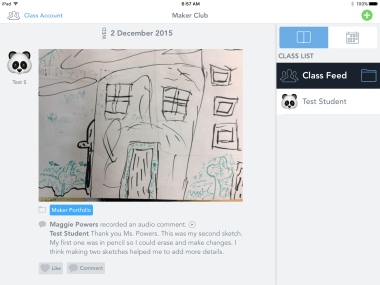
- Students will engage in ongoing documentation of their work. It will be captured with the Seesaw app and saved to their “Maker Portfolio” folder. This includes:
- Photos
- Videos
- Drawings
- Audio recordings
- Short text

- Peer Feedback
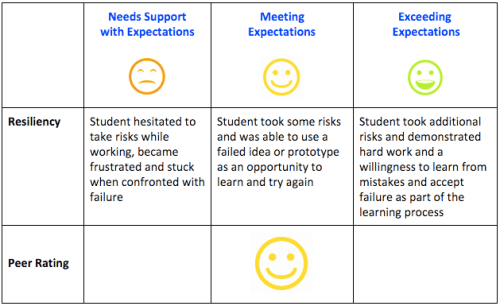
- At key points (e.g., transitioning from brainstorming to planning and planning to building) during the creation process, students will be invited to share feedback with their peers. This feedback will be based on a rubric that defines (in developmentally appropriate language depending on the grade) resiliency, documentation, creation, collaboration, empathy, reflection, and being a problem-finder in a way simple enough for students to understand. They will record narrative comments in Seesaw and possibly even take a photo of their assessment for each criteria (recorded as a sad face = not meeting expectations, simple smiley face = meeting expectations, and excited smiley face = exceeding expectations; see below) . This will allow students to provide incremental feedback at key turning points in a project and also easily see how a project has developed by being able to review everything in a single student’s’ portfolio.
- Mid-way through the building/making part of a project, students will also use the “love notes” (Flores, 2015b, p. 45) approach to leave additional feedback and encouragement for their peers. This feedback will be done with markers and sticky notes and documented through photos so it can be added to Seesaw.
- Self-Assessment
- At this point, students will pause and take time to review their work, the feedback they have received along the way, and the love notes they have added to their portfolio. They will be asked to add a comment in Seesaw to the photo of their love notes, summarizing the feedback they received and reflecting on how it can help them to improve their project.
- Teacher Feedback
- As the teacher, I would assess students on the same mindsets and criteria students use: resiliency, documentation, creation, collaboration, empathy, reflection, and being a problem-finder. I would provide written feedback to them about how well they met each one of those criteria. I will also provide informal feedback and scaffolding to students via Seesaw comments throughout their project to prompt them to think more about a problem or consider a new question or way of working.

- Self-assessment
- Students will complete a final reflection on what they learned through the making process and how they might use that learning in their next project. They will be asked to consider how documenting and getting feedback on their work throughout the process affected their final product. This reflection will be done as a note (written or narrated) in Seesaw, so all of the documentation for the project remains together and can be easily shared with peers or external audiences.
- Students will then share their project and key points from their final self-assessment with the class (and at times, a larger audience).
This is a new process and I am curious how other teachers assess the making and learning that happens through these types of maker projects. Are you using rubrics, written feedback, self-assessments or some combination of them all?
Sample Peer Assessment for “Resiliency”
References
Blikstein, P., Martinez, S. L.., & Pang, H. A. (Eds.). (2015). Meaningful making: Projects and inspirations for fablabs and makerspaces. Torrance, CA: Constructing Modern Knowledge Press.Doherty, D. (2013). We are makers. [Video file]. Retrieved from http://www.wearemakers.org/
Doherty, D. (2013). We are makers. [Video file]. Retrieved from http://www.wearemakers.org/
Flores, C. (2015a). Alternative assessments and feedback in a makered classroom.In Blikstein, P., Martinez, S. L.., & Pang, H. A. (Eds.), Meaningful making: Projects and inspirations for fablabs and makerspaces (pp. 30-37). Torrance, CA: Constructing Modern Knowledge Press.
Flores, C. (2015b). The role of peer assessment in a maker classroom.In Blikstein, P., Martinez, S. L.., & Pang, H. A. (Eds.), Meaningful making: Projects and inspirations for fablabs and makerspaces (pp. 42-47). Torrance, CA: Constructing Modern Knowledge Press.
Tesconi, S. (2015). Documenting a project using a “failures box”. In Blikstein, P., Martinez, S. L.., & Pang, H. A. (Eds.), Meaningful making: Projects and inspirations for fablabs and makerspaces (pp. 40-41). Torrance, CA: Constructing Modern Knowledge Press.
Wiggins, G. (2012, February 3). On assessing for creativity: yes you can, and yes you should. [Web log comment]. Retrieved from http://grantwiggins.wordpress.com/2012/02/03/on-assessing-for-creativity-yes-you-can-and-yes-you-should/
Yokana, L. (2015, January 20). Creating an authentic maker education rubric. Retrieved from http://www.edutopia.org/blog/creating-authentic-maker-education-rubric-lisa-yokana








 Margaret A. Powers
You must be logged in to post a comment.